• MY BOOKS ON WILDLIFE, GARDENING AND MORE

  • The Wild Excellence

  • True stories of wildlife encounters around the Greater Yellowstone
  • Award winning eBook on Decomposed Granite, tips, how to's, what to watch for
  • Children's book. True stories of a dog and wolves. In a dog's voice
  • Written for dry Mediterranean climates in California, north and south

An Advertisement for Yellowstone!

Happy Mother’s day.

Since my son is in New York, I gave myself a present.  The last few days have been either too busy or too cold to go into the Park.  I heard the road opened earlier than the scheduled date, Friday, the 8th.   So on Thursday I headed up towards Cooke City.  I never made it because of a snow storm.  Not that the snow was so bad, but I figured the animals wouldn’t be out.

This morning I woke up early and was out the door by 7am.  I’m only 40 minutes from the Park’s entrance; an hour from the Yellowstone Institute in the Lamar Valley.  Because I had the dog, my plan was to visit for 1/2 day, and take a hike outside the Park the other half, with the dog.

In the span of those 3 hours in the Lamar (or on my way there), I saw: (disclaimer…sorry my photos up close are not great.  I just have a small digital camera that I use because its lightweight for hiking.  Maybe I need to get a better one as well.)
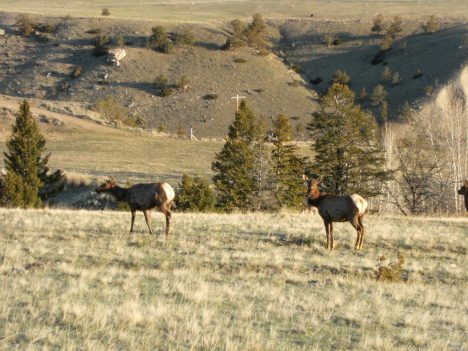
Elk in my Valley.  I thought elk on left looked quite pregnant.

Elk in my Valley. I thought elk on left looked quite pregnant.

First thing on the way to Chief Joseph were some early morning grazing elk.  They are getting ready to calf soon.  My neighbor, on whose pasture these elk are grazing, called me yesterday to tell me to watch my dog as a wolf walked past her daughter yesterday.
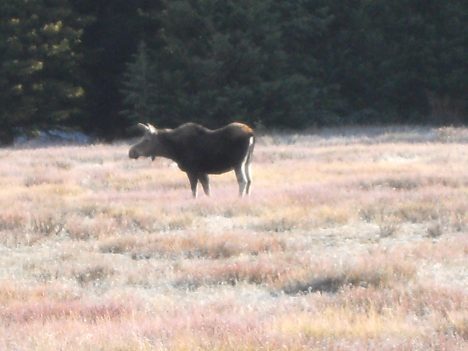
Moose on Chief Joseph Highway

Moose on Chief Joseph Highway

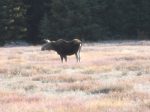
These two moose were up past the 212 turnoff to the Park, right alongside the road.  I didn’t see any moose in the Park, although usually some hang out in the river right past the NE entrance.

This one just sat and watched me.  She had frost on her fur.

This one just sat and watched me. She had frost on her fur.

Here’s the approach to the NE entrance.  There was no ranger at the gate today, so no entrance fees.  Happy Mother’s day.

Entrance to Park

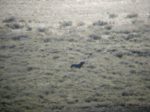
Not too far into the Lamar Valley, I stopped by a crowd with scopes.  I watched 2 wolves for a long time, one a collared gray female and the other a black.  They seemed to be trying to figure out how to cross the creek and road to get back to their den on the other side.  There was a lot of howling and prowling.
This is through the scope.  He was way across the Lamar river.

This is through the scope. He was way across the Lamar river.

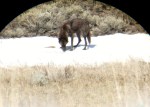
Pronghorn were all over the hillsides.  Bighorn sheep were grazing high up.  I continued down the road a bit, still wanting to see some Bison babies, when I was distracted by another black wolf of the Druid pack, very close to the road.  I stopped and watched with my naked eye.  He was walking back and forth along the stream bed.  He was so close to the road that I thought he wanted to go to the other side as well.   Suddenly, he had something in his mouth.  It was a fish!  He brought the fish over to a nearby snowbank (all this within 200 feet or so of the road), played with it,  rolled on top of it, then devoured it as a magpie watched.

Wolf eating a fish he just caught
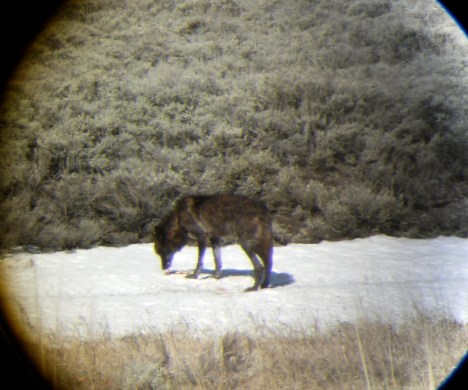
Wolf eating a fish he just caught

Wolf eating a fish

Wolf eating a fish

Finally I moved on to see the Bison calves.  The one animal we don’t have in our valley next to Yellowstone is Bison.  They wouldn’t be allowed to migrate out of the park.  Granted, they do shoot a lot of wolves outside the park, but they return and soon reform local packs.  In addition, each state is required to have a certain amount of wolves in their delisting program.  But Bison no state will tolerate because of the perceived threat of brucellosis to cattle.

Here are the baby pictures:
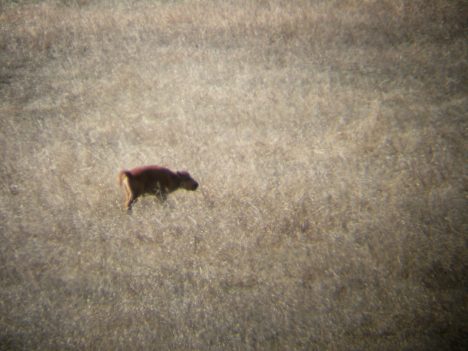
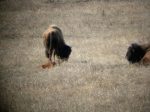
Bison calf

Bison calf

Mom with two calves in the grass nearby

Mom with two calves in the grass nearby

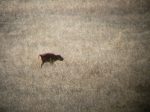
If all this wasn’t enough (I’d barely driven a mile within the Lamar), I went a short distance down the road to view the Grizzly hanging out within 100 feet of the highway.  He’d been there all morning.  On my way, another black wolf walked through a herd of grizzlies.  He was joined by a grey and they both began howling.  They were answered by a wolf on the other side of the road, not visible to me, near their den site.  A coyote began yipping in tune to the wolves, and then he sauntered across the road.  Several Red Tail hawks circled overhead, while Sandhill Cranes walked along the water’s edge.

Here is the bear:

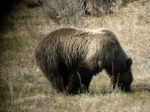
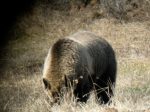
This grizzly spent hours upturning Bison paddies for insects underneath
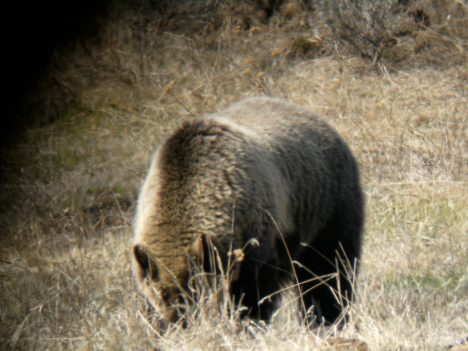
This grizzly spent hours upturning Bison paddies for insects underneath

Grizzly rooting around

Grizzly rooting around

I’ve oftened pondered what makes for that special nurturing quality of Yellowstone.  I left the valley and could feel its warm embrace.  There is so much life there.  The animals seem at peace, not threatened.   They are simply doing what they do, going about their business.  There is always a palpable feeling in the air there, like a slice of heaven.  Is it the volcano living underneath?  All the hot springs?  I think its where the natural order of things are in place.  In Yellowstone, man is not the top predator.  This has been so for generations upon generations of wildlife and they ‘know’ it.

It is time to acknowledge Yellowstone for what it truly is–the serengeti of North America–and treat its surrounding environs as such.  Outside of the Park, they are supposedly ‘protected’, but special interests always come first.  Buffalo cannot migrate to lower ground in the winter or they are killed; wolves even when they weren’t delisted were killed regularly (they know what the sound of a helicopter means outside of the Park); right now is bear hunting season in my valley.

The income from open grazing or from hunting tags pales in comparison to tourists coming to see our ‘Serengeti of wildlife’.  Having the Cattle or Sheep lobbyists win every legislative battle is old school.  It is time we see what we have here that is truly of value, and so unique.  It is time to preserve this land of the Greater Yellowstone Ecosystem, not just Yellowstone Park, and manage it with wildlife as the number one priority.

There couldn’t have been a better advertisement for Yellowstone as this mornings two hours in the Lamar Valley.

Some Scat

I thought I’d post a scat entry with photos.  Some I’m sure of, many I’m not.  Not all have size references.  Sorry about that.  I’m now starting to carry around a penny which I’ll put with future photos.  A penny is exactly 3/4″ in diameter.

Breaking up scat helps in identification and is a window into what the animal was eating.  Smelling scat (do not smell raccoon scat as they can carry a parasite that is fatal to humans) also holds clues.

Animals communicate vast amounts of information through markings and scat.  Many times I’ve watched Koda intently smell an area, then urinate on it.

Koda with his nose in a squirrel hole

Koda with his nose in a squirrel hole

One time he was smelling a log that had no obvious scat on it.  Because he is still a pup, he started licking the log to ‘uptake’ the smell better.  I got down and smelled the log and was overpowered by a extremely pungent smell.  Other times he spends a lot of time smelling an area and when I put my nose to the ground, I can’t discern anything.

One time in California I was at the tracking club meeting.  We were circling a large field and found mountain lion scat.  The group leader advised everyone to get down and sniff it.  One whiff of that scat and you’ll never forget it.  It made the hairs inside my nose stand on end for a long time.  Imagine your kitty litter box, then multiply that smell 10-fold.

Last year in the spring I had both my dogs with me in Wyoming.  My old dog started making a beeline for the woods.  I followed her to a fairly fresh turkey kill, probably from a coyote.  The kill was in the nearby vicinity of the cabin and the magpies were already on it.  The 2 dogs spent lots of time chewing and further demolishing it. Early the next morning, on the walkway in front of my house, a coyote left his fresh scat.  My old dog smelled it, but before I could hardly look at it, the 6 month old dog gobbled it up.  Koda was still learning about smells and scats, and eating it is another way to really remember it.  (I, personally, will not go that far!)  I had the distinct impression this particular scat was left for my dogs as a calling card, as if to say, ‘this is my territory and that was my turkey you fooled with.’

I’m a crazy beginner at this.  I find it’s a fun way to explore what’s happening around me. Learning scat takes practice and lots of direct experience.  I take photos, then go home and look at Mammal Tracks & Signs by Mark Elbroch.  Elbroch’s book contains tons of color photos throughout.  He includes photos of tracks, scat, as well as sign.  The book is thick at over 750 pages. Too bad he doesn’t include ‘scratch and sniff’.

Unknown scat

This one's unknown, found in the woods nearby

Marmot in hole with scat above

See Marmot scat at top of photo. Marmot's in his hole.

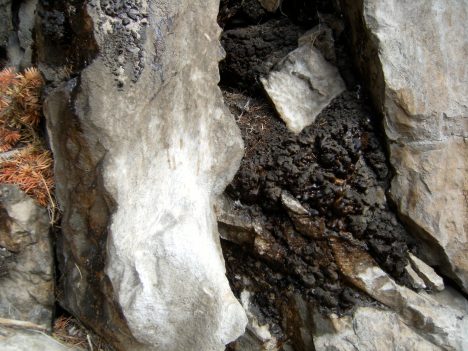
pack rat scat

Years of pack rat scat.

Canid scat

Could be coyote or wolf. 25% of wolf scat is coyote size.

Bobcat I think.  Smells like it.

Smelled like a cat. Bobcat I think. Cat's digest 90% of the bones.

Owl droppings

Owl on tree. Notice the white droppings.

Bear sweet smelling scat in the spring

Big pile of bear scat. All forbs/grasses. They clean themselves in the spring with grass.

Mustelid I think.  Smelly and strong.

Some kind of mustelid I think. It was skunky smelling.

Another mustelid, I think.  On the same trail as the other scat.

Another mustelid, I think. On the same trail as the other scat.

Grizzlies and the Edge of Eden

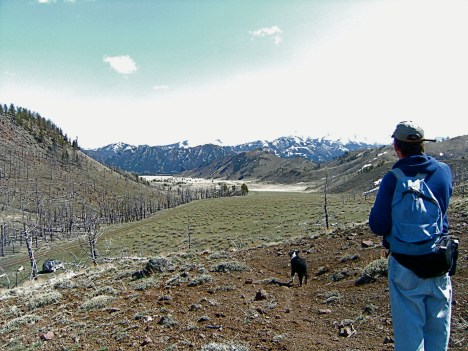
The last two days I hiked into several drainages where the hottest spots of the Yellowstone 1988 fires burned.  After 20 years those soils are still so sterile that no new trees are growing.  Hottest area of the '88 fires.  Sterile ground, good forageThis is an area of excellent forage though, with young sweet grass and sagebrush.   Pulsatilla flowers just emerging nowThe snows are just beginning to melt and seasonal streams are running.  With a forest of dead timber, standing and downed, the run off will be fast and furious.  But its early still and the streams are gentle.  A huge log jam up river, crazy every which way, testifies to last years’ fury.

In summer, without the advantage of shade,  this place is too hot to hike in.  In the fall, it is full of hunters hoping to kill bull elk migrating from the Park. There is a strangeness here, the dead trees stand as sentinels against the hoodoo-like rock carvings from ancient lava flows.Dead trees and lava hoo doos

This is grizzly country.  They inhabit these draws, drainages that rise abruptly into high meadows; forests thick with Lodgepoles and Limber  Pines.  Spring is the best season here.  The dead timber provides homes for insects that attract an abundance of birds.  A woodpecker fights a flicker for territory, running him around and up a dead tree.  Finally the flicker retreats.  I find it curious this jockeying for dominance in an area of abundant food.There is a strangeness here

We saw grizzly tracks both days.  On the second day we followed a grizzly trail, although we were backtracking him. Grizzly track The trail, not on the map, was a highly used game trail that went up the wide mouth of the drainage. At times the downed trees were so thick the trail disappeared.  When the trail faded, we watched where the grizzly had chosen to go, figuring he’d have taken the path of least resistance.  It led up the creek bed, the stream disappearing and reappearing in odd places.   At one point, we crossed under a large downed tree trunk,.  The tracks passed directly underneath so we looked for fur stuck to the nubby remains of the branches.   There were a few hairs there.  Claw marks on trees noted where a grizzly stopped to mark his territory.  They were so high I couldn’t reach them.  That’s a big bear.Grizzly scratches on pine tree
Another tree with grizzly marks
A coyote,  running in our direction on the far side of the draw, suddenly smelled or heard us, and decided to turn back.   A bloody leg dangled from his mouth.  Koda noted the spot near the trail where the kill might be, but I called him back, fearing we’d find that grizzly there.  On the way back down, we walked over to the site Koda found.  A kill a few days old, the only remains was a small rib cage of a young elk or deer.

Its grizzly time right now.  They won’t be going high to find their moth sites until sometime in July.  Tonight  I watched a powerful video about  Charlie Russell called The Edge of Eden: Living with Grizzlies.   Charlie grew up in Canada  on an outfitter’s ranch.  He was a cattle rancher for years and had to deal with grizzlies.  He found that if he left out some winter kill cattle for the hungry grizzlies in the spring, they’d leave his cattle alone the rest of the year.  He wanted to understand grizzlies better and went to Kamchatka, Russia where the local zoos kill orphan cubs.  He began bringing these cubs back to the wilds, acting as their mother and protecting them for a year, sometimes two, then allowing them to roam free.  It’s a marvelous video  (that won several  film festivals) and story about a man trying to help restore respect for the grizzly as well as pioneer new strategies for those living in grizzly country.  To order the video, contact skyfilms@xplornet.com.

Badlands, Wild horses, and natural gas wells

Yesterday was the Greater Yellowstone Coalition (GYC) Cody Chapter annual spring hike.   This year they decided to go to McCullough Peaks, outside of Cody.  McCullough Peaks is badlands east of Cody.  It’s also a wild horse preserve and parts of it are Wilderness Study area.

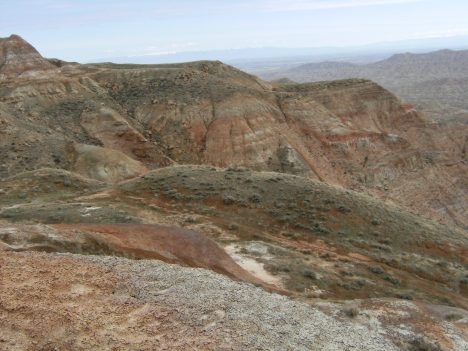
McCullough Peaks, named after Pete McCollough who drove cattle to the southfork in 1879 for Judge Carter’s cattle company, is a stark and beautiful landscape.  The earth tones vary from reds to purples to shades of tan.  Numerous and dangerous sinkholes line the broken trails.  Its a land that one might look at and say “Nothin’s here”.  But I’ve hiked it twice now in the last three weeks and I beg to differ.Badlands, McCullough Peaks

My first hike several weeks ago the land was just beginning to green up.  Now’s the time the desert is fertile and blooming, lasting about a month.  You have to time your hike a few days after a snow or rain, otherwise the mud is a murky maze, hard to avoid.  One of the GYC members said this land is part of the Crocodilian age, rich in fossils from the Eocene, 38 to 58 million years ago when seas covered and then receded from the basin.

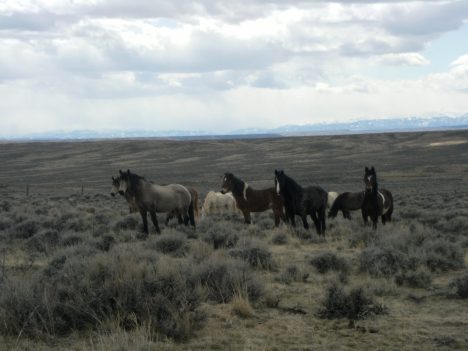
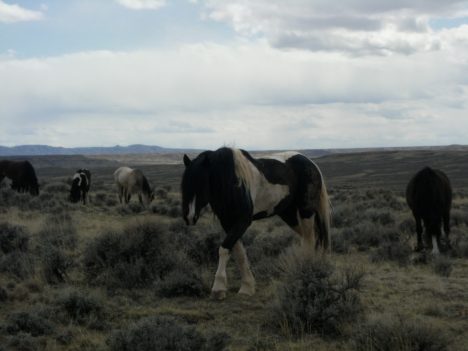
Hiking close to the herd, W__ and I kept our 50′ distance, but the wild horses decided to check us out more closely.  A mare and her foal came over, sniffed us, and decided we were fine to be on their land.  Its amazing these horses can even survive.  With rainfall only 5 to 8 inches a year, they seem to find food.  The BLM maintains some stock reservoirs that the horses use, as well as the open range cattle.Wild Horses

Wild Horse

The GYC hike was to Peak 6224.  Although it’s only about a mile distance, I found the trek difficult going up and down barren, steep, slippery soil.  From the summit of Peak 6224, you could see the entire basin–Carter Mountain, Heart Mountain, north to Beartooth Plateau and Powell, east to the Pryors and the Big Horns.  The greens of the new grass highlighted the hues of reds and purples, with the snowy peaks as a backdrop.  It was beautiful.  Purples of desert soil

Sinkhole, some are large enough for a man to fall through

View from the peak looking east

GYC chose this hike because on the other side of the road from the hike is where the proposed Natural Gas development is.   At the end of the hike we continued on the road over the hill to view the site.  One well has already been drilled and the toxic waste holding pond is full.  The 6 acre pad is built, but because of low gas prices right now, the well is waiting to be functional.

Open smelly pit with toxic hydrocarbon and chemical waste

This pit is supposed to be protected from birds as well as mammals

Gas pad still not reseeded and recontoured

6 acre pad should have been reseeded and recontoured

Hillary Eisen of the GYC staff explained that this is the first of many proposed wells in the area.  This well was an exploratory drill and they seem to have found enough gas to justify continuing.  She also explained that the 6 acre pad is allowed for the trucks to get in and create the well, but they’re supposed to have re-contoured and seeded the area by now, which they hadn’t.  Also she said that they don’t need to have an open pit for the toxic water waste; that it could just as easily be in a container.  The pit is supposed to be covered so birds can’t get in.  The pit had a real toxic smell.  In addition, there was garbage everywhere when we drove up.  They’re supposed to clean up the mess they leave.

This is the well, capped for now because prices are low.

This is the well, capped for now because prices are low.

This well is on state land.  Several of the others are on BLM land.  The state leases parcels of land with little environmental impact necessary.  They justify their leasing on the basis of the land paying for schools.  The BLM as a federal agency requires input from citizens and reviews.  But, Hillary explained, almost 100% of the time they approve development requests.

Once the wells are drilled and operating (when natural gas prices go back up), either pipelines need to be built or trucks will be going in and out to transport the gas.  Traffic will increase, more holding ponds with more toxic waste will be built, and a large generator for the pumping will be operating 24/7.  The noise from this generator will be constant and deafening.  McCullough Peaks will be a very different place, more on the order of a mini-Jonas field.  The solitude that makes parts of these lands eligible for a Wilderness area will be no longer.Beauty and solitude of McCullough Peaks Wilderness Study Area

Natural gas may be, as Hilliary explained, our transition fuel to greener technology.  It has a lower greenhouse gas impact than oil does.  But that doesn’t mean we can’t drill in more conscious ways.  This site, with the garbage strewn along the road and the plot, the negligence in restoring the area, the open unnecessary and smelly pits, as well as the types of generators that will be involved with the noise levels in the future–all that is done in the name of low costs.  I would call it pure neglect and unconsciousness.

“Don’t let people push you and say you have to provide energy for the nation.  It is not unreasonable to say there is a point at which we don’t want this to become an oil and gas Appalachia.”–Gov. Dave Freudenthal

The Orphan Road

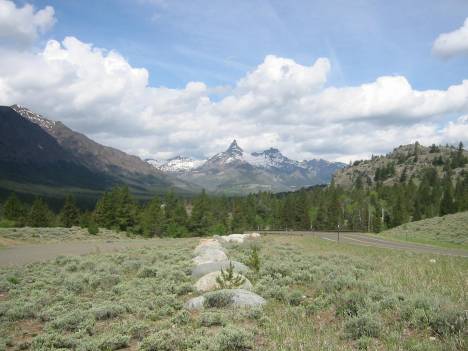
I am just counting down the days until the Park opens. Its frustrating because we seem to be last on the list.  The Park newsletter says May 8, if conditions allow, Chief Joseph will open to the Northeast entrance.  Yet treacherous Sylvan Pass opens May 1 with no conditions attached.Pilot and Index Peaks from Chief Joseph Highway, May/June

There are only eleven miles of unplowed good highway between Chief Joseph/Beartooth highway and Cooke City.  I’ve asked my neighbors several times to explain the politics of plowing that road.  Its complex because it would seem to be the responsibility of Montana, as Wyoming plows their side.  But from what I understand, no one wants to claim it.  Its the ‘orphan road’.  The Park maintains the Beartooth (hwy 212) because that’s a federal highway.  But the Beartooth highway is not plowed in winter, for obvious reasons.  And they don’t want to plow the small stretch from the Wyoming border to Cooke City in the winter, which would leave Hwy. 296 (via 212) fully open to traffic from Cooke City to Cody in the winter.  Instead, a local in Crandall grooms that stretch for snowmobilers.

The odd thing is that once you’re in Cooke City, the North Road in Yellowstone is plowed so the kids can get to school and Cooke City isn’t landlocked.  So if, for instance, I drove to the end of Chief Joseph and parked at Pilot Creek, skied the 11 miles to Cooke City, then how do I get into the Park without a car?    It’s 11 miles of sheer frustration.  The town of Cooke City would like it plowed (at least that’s what some of the local businesses have suggested to me), but they must be too small for political clout with the feds.

The town of Cody on the other hand has lots of political clout it seems.  They’ve pushed the Park every year to keep Sylvan Pass open as a groomed road for snowmobilers.  They seem to be under the illusion that keeping that entrance open attracts winter tourists and money for the town.  The figures for 2009 are in and only 97 snowmobilers went in through the East Entrance, at a cost of $325,000 to the Park.  That’s $3500 per snowmobile!  No snow coaches went through.

I’ve only been here 4 years, but here’s the logic the way I see it.  Sylvan pass is dangerous.  To keep the pass open and safe in the winter, the Park has to induce avalanches.  Its a treacherous road.  It’s beautiful but dangerous.  Chief Joseph highway via Dead Indian Pass, on the other hand, is plowed all winter.  It’s also incredibly beautiful and accessible via Cody and Codys’ airport.  The extra 11 miles of highway is a good road and not over a 8530′ pass.  My neighbor tells me they paved Chief Joseph always with the intention of it being the winter access into the Park.  So why doesn’t Cody push to open that in the winter?

It is because there is a false view that Cody is receiving winter business from their East gate.  Numbers say they aren’t.  But people could fly into Cody and drive into Mammoth or vice versa if those 11 miles were plowed.  I’m sure the costs wouldn’t be $325,000 to the Park.  Just the cost of paying the guy already plowing the North road a few extra bucks.

One group pushing to keep that part of the road closed is Cody Country Snowmobile Association. They argue that the area is world class snowmobiling, it attracts lots of people from out of state, and money is made for the state on the tickets for snowmobiles, as well as money spent in town by the tourists.

I’m no fan of snowmobiling.  They are too noisy for me.  I am a hiker and like to feel the quiet of the woods and see the animals.  But I’m sure if $325,000/year wasn’t spent on Sylvan Pass (the snowmobilers prefer the Beartooths anyways for its challenge and freedom), some of that money could be redirected (maybe in partnership with other state agencies that are likely to benefit) to create new access trails for snowmobiles, working out a plan that would please both the CCSA and people like me who want to gain access into the Park in the winter, as well as provide that extra revenue from tourists that Cody is looking for.

On the bright side, keeping that road unploughed, although we have lots of weekend car traffic from Cody to Pilot Creek with snowmobiles in tow, helps insure that my area of the valley is nice and quiet in the winter.   Maybe things are well enough left alone.  Regardless, I’m anxious for May 8 to take an afternoon drive into the Lamar and see the Bison babies.  Pronghorn in Lamar in spring--Northeast entrance

Spring storm brewing in Yellowstone, NE entrance

Lamar Valley, springtime

Chief Standing Bear and Grandpa

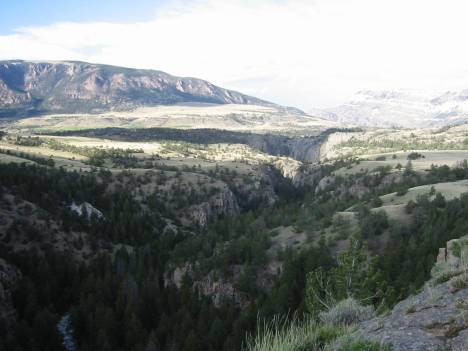
My neighbor JB was born in 1924 in my valley down by the Clark’s Fork.  His parents’ homestead is in a unique and beautiful hollow below the main road.  From this hidden depression, you can look out over the meadow where their horses graze and view Bald Ridge directly on.The flats above the gorge of the Clarks Fork

Bald Ridge

Yesterday it was snowing so I went to visit JB.  He told me this story:

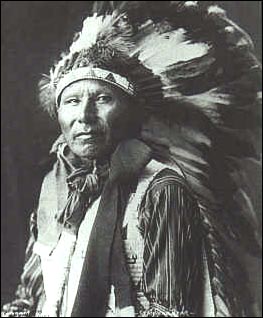
My grandfather was born in Nebraska.  When he was just nine years old, he was playing and broke his leg.  His father was a hard man and beat him for that.  My grandpa swore to himself that when he got better he was going to run away and he did, at 10 years old.  He and a friend were catching rides on freighters going down river, going West.  They hitched a ride on a wagon that was attacked by Indians.  The Indians killed everyone in that wagon train, including his friend, but my grandpa hid in a flour drum.  The flour was in 55 gallon drums and he hid behind one.   The Indian Chief and his wife found the boy and the Chief’s wife took pity on him.  They took him back to the tribe and raised him with their own child, which I think was a girl.  That Chief was Standing Bear.  My Grandpa lived with them for 5 years. Chief Standing Bear--I think its this one.

The Indians liked to gamble and compete.  There was one boy the same age as my grandfather who didn’t get along with him at all.  When my grandpa was 15, this boy challenged my grandfather to a horse race.  Grandfather was an excellent horseman and he was winning.  The Indian boy was mad and pulled out a knife.  Grandpa knocked that boy down, off his horse, and I think he killed him.  Or hurt him badly.  No, I think he killed him, but it was kill or be killed.

The whole tribe had a meeting.  Since my grandfather was white, they banished him.  Chief Standing Bear and his wife took my grandpa in the middle of the night, on horseback, and told him he should leave and go far away; far enough away so no one in the tribe would come after him.  The chief told him that he would always love him and think of him as a son, strong, brave and worthy to become a chief, but that now he must go.

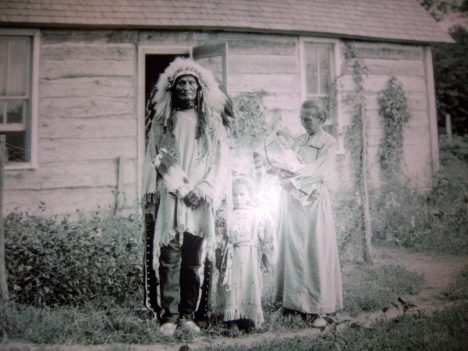
Photo of Chief and family from the Buffalo Bill Historical Center

Photo of Chief and family from the Buffalo Bill Historical Center

Grandpa came out to this country and spent time here with the Shoshone as well.  He was working at Pahaska Teepee taking people into the Park when Buffalo Bill came out here.

It is true he had a wooden leg.  He was logging and in an accident.  His leg broke, a clean break right here (points to below his knee).  He knew how to set bones and had set many breaks on other people. But they took him to a doctor who cut off his leg at the knee.  That shouldn’t have been.  He’d wear lots and lots of socks over that peg to cushion it against his knee.  But he could do anything he wanted with that leg.

He lived near the mouth of the Clarks Fork.  One time us kids were down there visiting.  My sister was taking a nap in the house and all of us other kids were down at the river swimming and fishing.  Grandpa was working in his shop nearby.  In those days there was lots of sheet lightening in this country.   My sister had just gotten up from her nap and was coming down to the river, when lightening struck the house.  You couldn’t do nothing.  In an instant, the entire house was in flames.  My grandpa thought my little sister was still in the house.  You should’ve seen him run with that peg leg!

I went to live with my grandpa when I was about 12.  I had a hard time finishing up those last two years of school between the 6th and 8th grades.  I did graduate though.  I only went till 8th grade.  Sometimes I was on the other side of the mountain going to school there.  They had a better teacher.  Sometimes I had to come back home and go to school here.  There were only 3 students here and all that teacher was interested in was the ranch hands. All that back and forth on foot and horseback over Dead Indian.  There wasn’t a real good road in those days, all dirt.  The old road went straight down the mountain.  From Cody it took four stout horses to pull an empty wagon up the hill most of the day. When you got to the top of Dead Indian, a man put a roughlock shoe on his hind wheels which kept them from turning.  Then he cut a tree, left all the branches on it, and chained it behind the load.  Then he headed straight down the hill, praying that his leaders would outrun his wheelers.Atop Dead Indian.  Strap a log behind the wagon to go downhill

Grandpa had really strong hands, all his life.  It was because he had spent so much time driving teams of horses.  You have to hold those reins between each finger and use your hands to hold back the horses.  He drove hay and other goods for a living.  I think he had done just about everything.  He was an excellent blacksmith and made all his tools.

It was a good story for a snowy day.  I thought about how I was just one hair’s breath away from Chief Standing Bear.  How less than a hundred years ago men knew how to do everything in order to survive–how to set a bone, fire and hammer out their tools, drive a team of horses.  I thought how our lives had become so quickly removed from those generations– so flaccid with the advent of electricity, large machinery, computers, phones–and wondered how much lore and skills have already been buried forever.

When I talk story with JB, I can feel him reaching back in his mind.  He has an impeccable memory for details. His stories contain names and dates.  He might have only an 8th grade education, but his powers of observation far surpass many I’ve met with college degrees.  I get him to tell me stories.  I write them down.  I listen.  They need to be re-told.

Getting to know my neighborhood at twilight

There’s a wonderful little forest next to my house.  Its where seven springs emerge out of the limestone that feed the cabins around here.  A trail leads through the woods to the meadows beyond.  Even though these woods are not large, and are surrounded by cabins, its a bustling place.My Little Woods

Deer, turkeys, coyotes, moose (on the lower end its marshy with willows), black bear and sometimes grizzlies, and plenty of small mammals frequent the area.  I’ve been trying to get to know my neighborhood, so I walk through the woods, exploring its smells and tracks, at least several times a week, mostly at dusk.

Last week I called a Great Horned Owl.  We had a nice conversation, back and forth.  He was roosting somewhere on the hillside, when a band of turkeys came noisily through the brush.  Maybe he didn’t like them scaring his potential dinner every which way, because he burst through the trees and flew down to the lower ends of the forest.  I did have to wonder if some of those turkeys’ young would be a nice meal for him this spring.

Several years ago, after the Point Reyes fires in California, the Park Service obtained money for Spotted Owl research.   I was lucky enough to help in the three year study.  My area was in a State Park with Redwoods and Douglas Fir, some of it old growth.  The first season was about locating the owls.  We learned to imitate their calls.  Owls, I found out, don’t care how exact your call is.  If I kind-of sounded like a spotted owl, they’d call back.

The next season we ‘moused’ the owls in order to find their nests and estimate the number of breeding pairs.  We brought lab mice into the field.  Since we already had an idea of the territory of the owls from the year before, we hiked to those areas, called in the owl, put the mouse on a stick and the male would take the mouse back to the female on the nest.  The third year we counted mature chicks.  The main predator of Spotted Owls is the Great Horned Owl–“The Lion of the Night”.

Helping with that study I learned a little about looking for owls.  The best way to find an owl is to spot their droppings around the base of a tree. Droppings at base of trees indicate owl roosts I’ve looked for this before in those little woods and easily found the roosts of Great Horned Owls and their pellets.  Pellets are not owl scat but the undigested parts of their food, regurgitated up in a large pellet.  If you open the pellet up, the evidence of their meal(s) is right there in the form of bones and hair.

Tonight though I was in for a surprise.  I was tooling around the woods at dusk like I do several times a week.  I decided to follow a deer run under some brush when I spotted some droppings at the base of a snag.   I bent down to get a closer look, and spooked a bird out from the top of the snag.  The bird flew to a nearby tree.  I felt there was something unusual about this bird so I told the dog lie down and I slowly crawled out from the low hanging branches and looked up.  It took me a few minutes for my eyes to adjust to the dim light and understand what I was seeing, as at first the bird seemed like a large robin.  It was a small owl, about 7 inches long, just as curious about me as I was about it. I adjusted my eyes I sat down on a log, watched and talked to the bird.  I found a pellet beside the log, about 1/2 the size of a Great Horned pellet.  After a long time, I crawled around and hung out with the bird from a closer and better angle. The owl wasn't afraid The owl wasn’t afraid at all.  In fact, he reminded me of Spotted Owls.  When we did our study, I was sworn to secrecy as to where the owls were located.  Spotted Owls are so tame that they can easily be approached and because they are endangered, we were especially careful.  This owl even started falling asleep while the dog and I sat there (Spotteds spend a lot of time sleeping too).
Hanging with that owl, I could see why there is a lore about them being ‘wise’.  Looking in his eyes, so close, he had an intensely calming effect on me.  Koda and I bade our goodbyes for the night and I went home to look up his name.  The Northern Saw-Whet Owl. I know Screech Owls also live in those woods because I hear them frequently.  But so does the ‘Lion of the Night’.  Stay safe little owl.Northern Saw-Whet Owl

The Bobcat

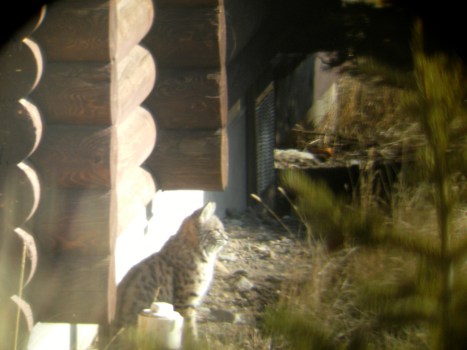
It was a beautiful morning.  I walked outside around 9:30 and threw the ball for Koda.  A large cat-like animal appeared out from the marshy meadows and stood next to the fence line.  Immediately I recognized it as a bobcat.  JB had told me several days ago that he saw a bobcat in his fields across the road.  I called the dog and sat down to watch the cat.  He was beautiful.  Much larger and more muscular than a big tomcat.Bobcat watching a ground squirrel

The bobcat sat in the sun for a few minutes when something caught his attention.  I looked across the meadows and saw a ground squirrel sitting on his mound.  The bobcat crouched low and made his way slowly in the squirrel’s direction.  He ran along the fenceposts, stopping behind one for several minutes.  He crossed a short span of meadow, then ran low along the side of the nearby house till he was directly in line with the ground squirrel.  At a distance of about 15 feet from the rodent, the bobcat sat perfectly still, watching and waiting.  Bobcat stalking amidst grass

By now the squirrel seemed to have caught wind that something was going on and was back in his hole.  The cat waited patiently though.  I’d been watching all this for at least 15 minutes.  I went inside to use my scope for a better view and try to shoot a few pictures.  Finally, the bobcat got bored and ran off to find an easier meal.

About 5 minutes after the cat left, I glanced out the window and saw the squirrel not just looking around from his hole, but on top of the nearby septic clean-out pipe.  I might be anthropomorphising here, but that squirrel seemed to be gloating to me.Gloating ground squirrel

When I was in California, I belonged to a tracking club.  We met once a month at Abbot’s Lagoon in Point Reyes.  That beach had lots of activity–coyotes, mice, otters, deer, opossums, racoons–but the most reliable tracks were of a bobcat.  The bobcat had an obvious route.  He started out from somewhere in the thick brush and followed a track alongside the lagoon.  There were latrines along the way and always kill sites.  Seeing that that bobcat had a regular hunting route, I wondered if my Wyoming bobcat had one too, and if I had observed him on it.  I have been investigating how to use ‘track plates’ and maybe I’ll try and make some.

Half hour later as I was driving my dirt road, I started thinking about how that bobcat lost his meal.  I wondered what made him give up on the ground squirrel, just shy of it reappearing.

Without warning, a Unita ground squirrel ran across the road.  I tried to veer but he was too slow and I was too fast.  Getting out of my car, I pulled him off to the side of the road, maybe secretly hoping my bobcat would find him.  I was still pretty close to home still and the thought that it was so easy for me to kill this squirrel and so difficult for the bobcat, haunted me.  There was something awfully strange in this synchronicity.  Bobcat print

Bluebunch wheatgrass and Junegrass

I have to do some reseeding where I put in a new septic last year.  The previous owners had a ‘septic’ that was a large hole in the ground in the middle of the front yard.  It was covered with dirt when I arrived with an upright stick marking the spot.  That way you wouldn’t drive a vehicle over it.  See the stick marking the box in the ground called a septic!

Before I purchased the house I had it inspected (trying to be good on my ‘due diligence’ and everything).  I hired a contractor who did a home inspection.  Besides his comment “Someone should never have had a hammer in his hands”, which fully described my place, he said he couldn’t find the entry point for the septic.  There was no record of it being cleaned nor installed.  Knowing full well someday I’d have to deal with that issue, I purchased the property regardless.

Last year when I came in April, I couldn’t help but notice a gigantic sinkhole at my front porch.  It was the cavernous entrance to my septic, now fully exposed.  We’d had plenty of water last spring and the ground finally just caved in around it.  Basically, it had been a big wooden box with a concrete pipe running into it.  The wood was gone but the pipe was still intact.  The hole was about 6 feet deep and wide.  I figured this was now an emergency before some kid fell into the hole. So I installed my new septic.

The new septic was a real one, with not just a tank but a leach field too, of course.  All that digging last May left a bare spot that evolved into a mud zone.  Of course I needed and wanted to reseed, but I wanted to do it ‘right’.  For me that meant native grasses–native to this ecozone.  New septic tank

Leach field.  This will be a muddy area soon.

Most people around here either seed for horses or cattle, or they put in a fescue lawn and water all summer.  I certainly wasn’t into watering.  Not only is it wasteful if it’s not necessary for horses or livestock (water is precious in the west, even if it does come out of my spring year round), but it’s just so much work (oh, the mowing!).  I’m not into that kind of work.  And being a designer from the West, lawn is just not compatible.  In fact, I could always tell where my clients came from by if they wanted a lawn on their property.

I’m not familiar with the native grasses in Wyoming, so I called up the forest service in Cody.  The Forest Service referred me to another department that deals with conservation.  They were very helpful, and gave me a list from a book of ‘low maintenance’ grasses used mostly on pasture land.  These weren’t necessarily natives, and if they were,not necessarily native to my site.

I happened upon the Dead Indian Archaeological botanical site evaluation.  It listed the plant communities nearby and the native plants associated with each one i.e. Sagebrush grassland or Open Grassland on shallow volcanic soil, etc.  There were 9 plant communities just around the Dead Indian site.  That site is fairly adjacent to my property, so I used that as a guide.  The community where my septic lies is Open Grassland on limestone soil. The dominant grasses here are Bluebunch wheatgrass (Agropyron spicatum)Agropyron spicatum--state grass of Montana

and Prairie Junegrass (Koeleria cristata)June Grass- Koeleria cristata Fescues (Festuca spp.) are found around as well.  So that’s what I’ve ordered.
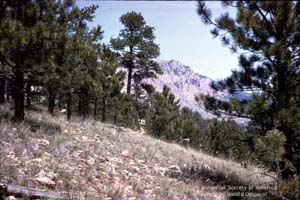
Its a perfect time to seed.  Its raining and snowing and sunny, sometimes all in one day.  The ground is moist.  New grass is starting to show.  The seed needs about 40 degrees to germinate and I’ll seed twice the rate, then cover it with straw to foil the birds.Native grasses 'look'.

For all those who care, I highly recommend bunch grasses.  For the West, they are our native perennial grasses, here for ions before the Europeans brought their cattle and with them came their annuals.  These reseed rapidly and overtake the smaller bunch grasses.  Because of Wyoming’s higher elevation, invasive annuals have not been as much of a problem as in other parts of the West.  But one, Cheatgrass, has been seen to be evolving into places not seen before.

My Kind of Wyoming

There is a rawness here.  A kind of un-forgetting.  Where forgetting can mean the difference between life and death.  A brilliant clear day of 60 degrees can suddenly turn into a snowstorm at 20 below.   The crackling of dry leaves can mean a grizzly and her cubs around the corner.   Your car breaks down on a lonely dirt road where no one travels for days at a time.

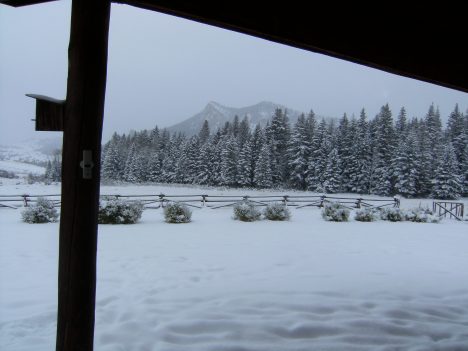
Vulnerability is the tenure of existence.  No amount of pretense or camouflage can make up for the visibility of that fundamental truth.  The sharp edge of living with that awareness draws the psyche into deeper places.  There is no hiding from the existential quandary of our aloneness.Changing Aspens after a October snowstorm

Elk in Geyser Basin, Yellowstone

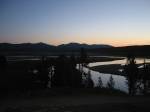
Dawn in Yellowstone

In a state as large as 97,000 sq. miles in area but with only a little over  600,000 people, this is the unspoken understanding people live with day by day.  You try and be prepared, but the truth is we are all dependent .  Rugged independence may be what is imagined by those passing through, fueled by the cowboy Hollywood image; one has to live here to know the extent of actual interdependence.

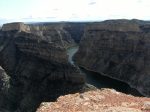
You may not care for your neighbors’ politics or drinking problem, but he’ll sure as hell be there for you when you’re broke down on the road or lost in a snowstorm.  A whole town will pitch in with a raffle or a fundraiser if you need medical care you can’t afford.  Total strangers do the unheard-of to help one another.  A young man from back east was lost in our area while hiking the cliffs.  One of my neighbors looked for him for over two years until he finally gave up.   A friend of mine risked his life to save a drowning stranger trapped on a frozen river, in an upturned truck, that he encountered while driving along a lonesome highway.Red River Canyon, Lander

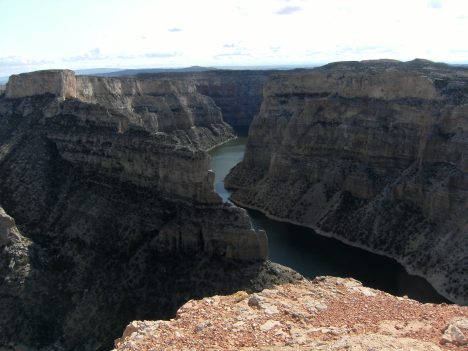
The intense quiet and overwhelming geography make long gaps in a conversation comfortable, even necessary.   It is as if the Human is subsumed by the largeness of the landscape.   I stop to say hello to a neighbor.  Standing in the dirt driveway by the fenced meadow, large cumulus clouds pass over.   The sky turns brilliant colors as the day comes to a close.  We pause to watch .  There is a rightness to it, as if in church—here, we are in church.  It is the Land.Big Horn Canyon

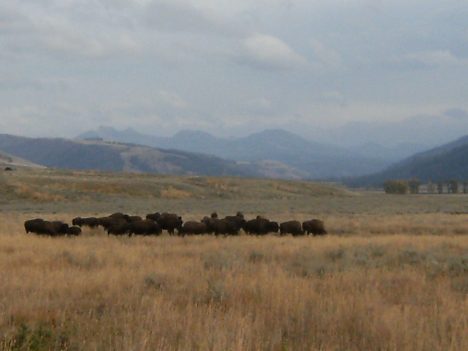
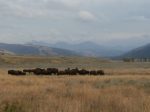
Thoughts are telegraphed rather than spoken.   The land itself starts to breath you, in and out.  The only forgetting is what comes with leaving behind the busyness, the necessities of ‘thinking to know’ and ‘needing to know’.  The rhythm of the natural world is meditation,  awareness,  alertness.  That seems to be the nature of consciousness for it is the key to survival.Buffalo in Lamar Valley

People here watch game.  They read the weather by the movement of the deer or the seasonal shifts of the birds.  They remember a year by the large population of Unita Ground Squirrels or the overwhelming plague of grasshoppers.  Time is punctuated by rare sightings–of a wolf making a kill, a mountain lion stalking a deer, the buffalo skull found by the river.Wild Horse in Big Horns

The art of storytelling is alive, well, and resuscitated.  There are stories of breaking horses, of rodeo riding, of guiding and ranching.  The time the tourist at Yellowstone was trying to push a Grizzly into the back of his station wagon to ‘bring him home’.  The 47″ trout caught ice fishing in ’62 down at New Fork Lakes.   The 9 cords of wood “I tried to sell ’em cheap” with the house, but that fellow said “I’m putting in electric heat”, and then it got 30 below in Pinedale, the electricity went off, and he had to haul his whole family to a motel in town.  Those are the abbreviated versions.  The embellished keep you captive.

Gretel Ehrlich, in beautiful prose that reflects her love affair with Wyoming, eloquently expresses it:

“…there is true vulnerability in evidence here.  Because these men work with animals, not machines or numbers, because they live outside in landscapes of torrential beauty, because they are confined to a place and a routine embellished with awesome variables, because calves die in the arms that pulled others into life, because they go to the mountains as if on a pilgrimage to find out what makes a herd of elk tick, their strength is also a softness, their toughness, a rare delicacy.” (The Solace of Open Spaces)

This is my kind of place.  This is Wyoming.Backpacking in the Beartooths