• MY BOOKS ON WILDLIFE, GARDENING AND MORE

  • Coming Fall 2024. Pre-order and use code 6AF24 for a 40% discount

  • The Wild Excellence

  • Award winning ebook on DG Primer

The Orphan Road

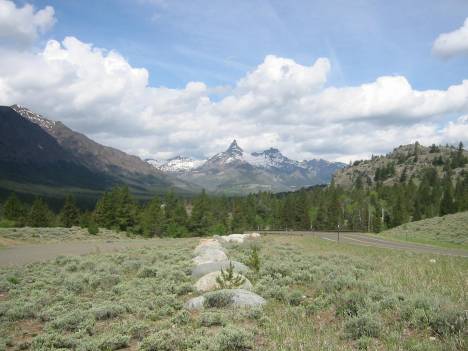
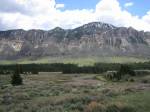
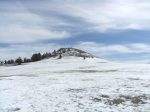
I am just counting down the days until the Park opens. Its frustrating because we seem to be last on the list.  The Park newsletter says May 8, if conditions allow, Chief Joseph will open to the Northeast entrance.  Yet treacherous Sylvan Pass opens May 1 with no conditions attached.Pilot and Index Peaks from Chief Joseph Highway, May/June

There are only eleven miles of unplowed good highway between Chief Joseph/Beartooth highway and Cooke City.  I’ve asked my neighbors several times to explain the politics of plowing that road.  Its complex because it would seem to be the responsibility of Montana, as Wyoming plows their side.  But from what I understand, no one wants to claim it.  Its the ‘orphan road’.  The Park maintains the Beartooth (hwy 212) because that’s a federal highway.  But the Beartooth highway is not plowed in winter, for obvious reasons.  And they don’t want to plow the small stretch from the Wyoming border to Cooke City in the winter, which would leave Hwy. 296 (via 212) fully open to traffic from Cooke City to Cody in the winter.  Instead, a local in Crandall grooms that stretch for snowmobilers.

The odd thing is that once you’re in Cooke City, the North Road in Yellowstone is plowed so the kids can get to school and Cooke City isn’t landlocked.  So if, for instance, I drove to the end of Chief Joseph and parked at Pilot Creek, skied the 11 miles to Cooke City, then how do I get into the Park without a car?    It’s 11 miles of sheer frustration.  The town of Cooke City would like it plowed (at least that’s what some of the local businesses have suggested to me), but they must be too small for political clout with the feds.

The town of Cody on the other hand has lots of political clout it seems.  They’ve pushed the Park every year to keep Sylvan Pass open as a groomed road for snowmobilers.  They seem to be under the illusion that keeping that entrance open attracts winter tourists and money for the town.  The figures for 2009 are in and only 97 snowmobilers went in through the East Entrance, at a cost of $325,000 to the Park.  That’s $3500 per snowmobile!  No snow coaches went through.

I’ve only been here 4 years, but here’s the logic the way I see it.  Sylvan pass is dangerous.  To keep the pass open and safe in the winter, the Park has to induce avalanches.  Its a treacherous road.  It’s beautiful but dangerous.  Chief Joseph highway via Dead Indian Pass, on the other hand, is plowed all winter.  It’s also incredibly beautiful and accessible via Cody and Codys’ airport.  The extra 11 miles of highway is a good road and not over a 8530′ pass.  My neighbor tells me they paved Chief Joseph always with the intention of it being the winter access into the Park.  So why doesn’t Cody push to open that in the winter?

It is because there is a false view that Cody is receiving winter business from their East gate.  Numbers say they aren’t.  But people could fly into Cody and drive into Mammoth or vice versa if those 11 miles were plowed.  I’m sure the costs wouldn’t be $325,000 to the Park.  Just the cost of paying the guy already plowing the North road a few extra bucks.

One group pushing to keep that part of the road closed is Cody Country Snowmobile Association. They argue that the area is world class snowmobiling, it attracts lots of people from out of state, and money is made for the state on the tickets for snowmobiles, as well as money spent in town by the tourists.

I’m no fan of snowmobiling.  They are too noisy for me.  I am a hiker and like to feel the quiet of the woods and see the animals.  But I’m sure if $325,000/year wasn’t spent on Sylvan Pass (the snowmobilers prefer the Beartooths anyways for its challenge and freedom), some of that money could be redirected (maybe in partnership with other state agencies that are likely to benefit) to create new access trails for snowmobiles, working out a plan that would please both the CCSA and people like me who want to gain access into the Park in the winter, as well as provide that extra revenue from tourists that Cody is looking for.

On the bright side, keeping that road unploughed, although we have lots of weekend car traffic from Cody to Pilot Creek with snowmobiles in tow, helps insure that my area of the valley is nice and quiet in the winter.   Maybe things are well enough left alone.  Regardless, I’m anxious for May 8 to take an afternoon drive into the Lamar and see the Bison babies.  Pronghorn in Lamar in spring--Northeast entrance

Spring storm brewing in Yellowstone, NE entrance

Lamar Valley, springtime

My Kind of Wyoming

There is a rawness here.  A kind of un-forgetting.  Where forgetting can mean the difference between life and death.  A brilliant clear day of 60 degrees can suddenly turn into a snowstorm at 20 below.   The crackling of dry leaves can mean a grizzly and her cubs around the corner.   Your car breaks down on a lonely dirt road where no one travels for days at a time.

Vulnerability is the tenure of existence.  No amount of pretense or camouflage can make up for the visibility of that fundamental truth.  The sharp edge of living with that awareness draws the psyche into deeper places.  There is no hiding from the existential quandary of our aloneness.Changing Aspens after a October snowstorm

Elk in Geyser Basin, Yellowstone

Dawn in Yellowstone

In a state as large as 97,000 sq. miles in area but with only a little over  600,000 people, this is the unspoken understanding people live with day by day.  You try and be prepared, but the truth is we are all dependent .  Rugged independence may be what is imagined by those passing through, fueled by the cowboy Hollywood image; one has to live here to know the extent of actual interdependence.

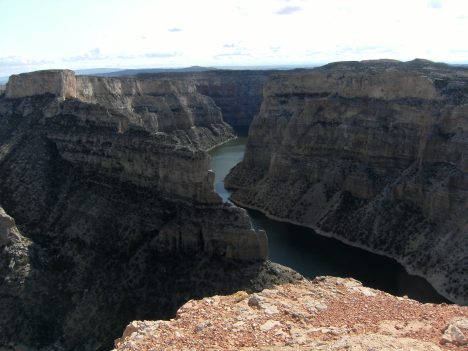
You may not care for your neighbors’ politics or drinking problem, but he’ll sure as hell be there for you when you’re broke down on the road or lost in a snowstorm.  A whole town will pitch in with a raffle or a fundraiser if you need medical care you can’t afford.  Total strangers do the unheard-of to help one another.  A young man from back east was lost in our area while hiking the cliffs.  One of my neighbors looked for him for over two years until he finally gave up.   A friend of mine risked his life to save a drowning stranger trapped on a frozen river, in an upturned truck, that he encountered while driving along a lonesome highway.Red River Canyon, Lander

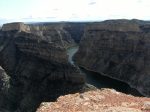
The intense quiet and overwhelming geography make long gaps in a conversation comfortable, even necessary.   It is as if the Human is subsumed by the largeness of the landscape.   I stop to say hello to a neighbor.  Standing in the dirt driveway by the fenced meadow, large cumulus clouds pass over.   The sky turns brilliant colors as the day comes to a close.  We pause to watch .  There is a rightness to it, as if in church—here, we are in church.  It is the Land.Big Horn Canyon

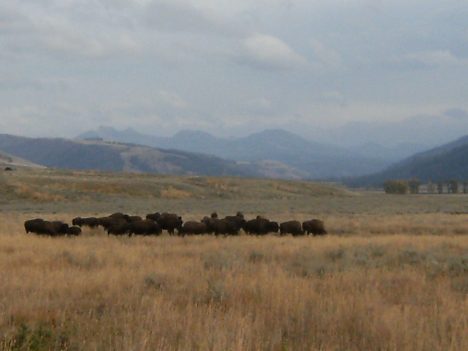
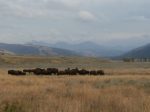
Thoughts are telegraphed rather than spoken.   The land itself starts to breath you, in and out.  The only forgetting is what comes with leaving behind the busyness, the necessities of ‘thinking to know’ and ‘needing to know’.  The rhythm of the natural world is meditation,  awareness,  alertness.  That seems to be the nature of consciousness for it is the key to survival.Buffalo in Lamar Valley

People here watch game.  They read the weather by the movement of the deer or the seasonal shifts of the birds.  They remember a year by the large population of Unita Ground Squirrels or the overwhelming plague of grasshoppers.  Time is punctuated by rare sightings–of a wolf making a kill, a mountain lion stalking a deer, the buffalo skull found by the river.Wild Horse in Big Horns

The art of storytelling is alive, well, and resuscitated.  There are stories of breaking horses, of rodeo riding, of guiding and ranching.  The time the tourist at Yellowstone was trying to push a Grizzly into the back of his station wagon to ‘bring him home’.  The 47″ trout caught ice fishing in ’62 down at New Fork Lakes.   The 9 cords of wood “I tried to sell ’em cheap” with the house, but that fellow said “I’m putting in electric heat”, and then it got 30 below in Pinedale, the electricity went off, and he had to haul his whole family to a motel in town.  Those are the abbreviated versions.  The embellished keep you captive.

Gretel Ehrlich, in beautiful prose that reflects her love affair with Wyoming, eloquently expresses it:

“…there is true vulnerability in evidence here.  Because these men work with animals, not machines or numbers, because they live outside in landscapes of torrential beauty, because they are confined to a place and a routine embellished with awesome variables, because calves die in the arms that pulled others into life, because they go to the mountains as if on a pilgrimage to find out what makes a herd of elk tick, their strength is also a softness, their toughness, a rare delicacy.” (The Solace of Open Spaces)

This is my kind of place.  This is Wyoming.Backpacking in the Beartooths

Pheromones, Pine Beetles, and more about fires.

I talked with the Wyoming Dept. of Forestry today.  Apparently, the state deals with private landowners, not the forest service.  I’m definitely going to go for ordering pheromones for my trees. Paul in the department told me that, yes!, the grizzlies do use the Limber Pine nuts as well as the Pinus albicaulus.  He also told me that because of lack of fires, the Limber Pines have become an invasive on rangeland.  Of course, I don’t have rangeland.  I butt up to a National forest full of Limber Pines from 7000′ all the way up to 8200′ or more.

He said they’ve been doing a lot of management with the North Fork and South Fork, but up till a few years ago, my area was doing okay enough.  “Not anymore” we both acknowledged.  The south facing slopes across from me are full of beetle kill on the ridge tops.  The end of my valley that butts up against the Park is now about 50-70% dead trees. Compare that to the east entrance to the Park (up the North Fork) which is about 90% dead standing timber.

The fires of ’88 came through parts of my valley and through Crandall, which is north of me.  In fact, the tiny town of Crandall was almost entirely engulfed and thanks to a major effort, was saved.  When you drive by Crandall, you can see where the fires came down almost to the town.  Apparently, it was some of the hottest fires.  Now the hillsides are regenerating with Aspens.  Cathedral Cliffs along Chief Joseph Highway

The point is, those fires near me in ’88 helped form a buffer from the pine beetle which spared my area up till now.  But like the economy, those fires of ’88 just ‘kicked the can down the road’, and now my valley’s time is up; due for a big fire.

This winter there’s been logging trucks on my dirt road daily.  The biggest private landowner is logging beetle kill around his property for fire protection.  The Game & Fish clear-cut a big swath of spruce and fir to make way for aspen growth, and the neighbor to my east is cutting and burning beetle kill weekly.  Everyone is aware: its only a matter of time till the fires come this way.

The thing about the blister rust on my trees is that they’ve weakened the pines, along with the many years of drought.  Paul said that usually the rust doesn’t kill the trees, especially in the Rockies due to the dryness.  And I can see that’s true.  These are older pines and surviving despite the brown needles.  But then the pine beetle finishes them off.

This is not a spruce or pine beetle but a wood-eating beetle that eats dead wood. They are scary looking though and BIG!

So I have a choice.  Spray with Sevin or use the Pheromone packets.  The spray lasts for 2 to 3 years.  The Pheromones only one.  But its a no-brainer for me.  I’m just not going to use a non-targeted toxic chemical.  Non-targeted in the sense that it kills beetles, and also other insects that could be beneficial; plus the other types of toxicity.

The pheromones simply are a chemical mimic that tell the beetles “This tree is occupied with beetles already.  Go find another tree.”  If you already have beetles in a tree, neither the chemical nor the pheromones will work.

Paul will come over and look at my property.  Its fairly expensive at $7/packet; but its for a good cause.  What we discussed is instead of just tagging important trees, I’ll do a grid of packets over my 6 acres.  When he comes over, we’ll look at the density and see if I need less than the 30 pkts/acre, which I think I will.  May is the target month to put the packets on the trees.  The beetles fly in July and August.

Good fires

If you live in the GYE (Greater Yellowstone Ecosystem), you probably know your trees.  You need to, because most people burn wood here for heat.  And each type of wood burns different, with more or less heat and more or less ash.

Being a horticulturist, I know my trees.  But conifers are hard.  I’ve taken three conifer identification courses over the past 20 years.  There’s a place near Mt. Shasta in California that, within a one square mile area, there are 22 different varieties of conifers!

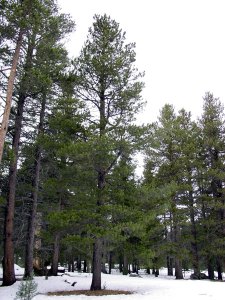
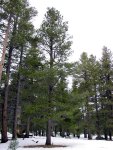
Luckily, there aren’t that many conifers out here.  In the Park, mostly what you’ll see are Lodgepole pines (Pinus contorta) because they grow on thin soils, which the park has because of all the volcanic activity.  Oddly enough, the dominant pine where I lived in California was also Pinus contorta, Shore Pine, but it looks nothing like a lodgepole.  Its twisted and shorter. Lodgepoles are called that because they’re nice and straight for using as a teepee shelter, or a lodge.Lodgepole pine Pinus contorta

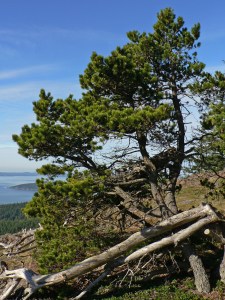
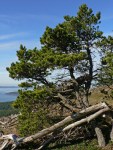
Last year I was looking at some new Shore Pines around 8 or 9 years old that grew after the Point Reyes fire.  They were at least as tall or taller than the Lodgepoles in the Park from the ’88 fires.  Same Genus.  Same Species.  Chalk it up to much more water, esp. in the way of fog.  To distinguish the difference, they’ve added another ‘contorta’ at the end.Shore Pine.  Pinus contorta

In California, if we want a good slow burning wood, we use Oak of course, a hardwood.  But there’s no hardwoods out here, so my friend G___ who was a forester for 20 years, explained some of the differences.

First I went and got a permit to cut wood.  There’s plenty of beetle kill up our road towards the park, and every year more and more.  We’re doing the forest service a favor by cutting down the dead trees.  The main problem as I see it with the beetle kill is that there hasn’t been a good fire here in 100 years.  That and global warming as we don’t get the really extended cold temperatures in winter anymore that kill the overwintering eggs.  Massive amounts of beetle killed trees at the end of my valley

We went far enough up the road to find some lodgepole.  Mostly there’s Engelmann Spruce around my cabin.  That doesn’t burn very hot as there’s not much pitch in it.  The second best is Douglas Fir (not a real fir.  Pseudotsuga menziesii vs. Abies [fir]).  The one to get around here is the Lodgepole.  I suppose its because there’s lots of pitch.  My friend tells me that the old-timers say “Every fifth log, put in an aspen and that will clean your chimney.”

Lodgepoles are fire adapted pines.  They keep their cones tightly on the tree.  These cones need a really hot day (113 degrees) or a fire to release their seeds.   You can age a forest by the diversity of trees.  After a fire, of course you’ll have prime grassland as forage for wildlife.  Within the first 40-200 years, a dense canopy of lodgepoles develops.  As these trees die, or if there are fires, with gaps in the canopy, doug firs and spruces will grow with the increased moisture.  In the drier areas new lodgepoles will sprout up.

Last year we had a fire up the North Fork that burned for over a month.  That whole area is full of beetle kill pines.  As the forest service was closely monitoring it to make sure no structures burned, there was a tremendous amount of controversy over why they weren’t just dowsing it.  My neighbor kept saying “They plan to burn up this whole country.”  The Cody Enterprise  ran critically-toned articles (even though the town was benefitting from the influx of firefighters).  Sweetwater lodge after Gunbarrel fire

G___ had a good explanation for the public’s lack of understanding of the necessity for fire in the west.  “When your neighbor was born here, for instance, this country had already had natural fires and the landscape showed it.  Over time, with fire suppression, the people here came to feel that what they saw was natural.  Its not.”

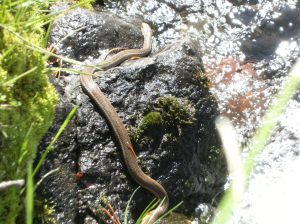
If you live in the West, you better be fire adapted.  The West is fire.  If you buy in the forest, beware.  If you buy up a canyon, beware.  The trees, the plants, the animals and their needs are adapted to fire.Water snake after one month in burn area

The Gunbarrel Fire last year was just about to jump over the pass to my valley, when a freak snowstorm happened over labor day.  I heard the Forest Service was secretly hoping it would come this way.  Not to burn homes, but to help the wildlife.  The elk desperately need better quality grass; the beetle killed trees need to burn up; and the soils and animals need those forbs that only sprout after a fire.

I suppose as a botanist/horticulturist, I can’t help but say to myself when I hike in these woods:  ‘This place needs a good fire.”

Coyotes and Communists

Oregon Basin is sagebrush desert surrounded by sandstone formations outside of Cody.  It’s desert hiking with so many things to explore.  I’ve only been there a few times.  Its a maze of BLM dirt roads, mostly used for oil and gas explorations.  One of the oldest oil fields in Wyoming, coal was also mined here from the late 1890’s to the 1940’s.   Old mines and buildings can still be found. But long before all of this, Native Americans camped and hunted in the basin.

On one of my few explorations here last year, a friend took me to a petroglyph site.  We drove through barbed wire gates, mile upon mile of windy dirt roads, past working derricks, until we parked alongside an abandoned coal mine.  We walked around a sandstone ridge to a small box canyon.  Protected from wind, it was the perfect campsite.  That’s where the petroglyphs were, along with a giant rattlesnake.  Sadly, many of the glyphs were defaced and beer bottles and trash was strewn around.Oregon Basin, Cody

I really like exploring the desert and its formations.  W__  spent 20 years hiking the basin and surrounding badlands.  Today we turned off onto a dirt road from the Meeteetse Hwy.  Someone had been killing coyotes and dumping them there.  Two fresh kills  attracted several Golden Eagles that flew off as we drove bye.  More old coyote carcasses were strewn along the way.  Coyotes rank as predator status.  That’s the status that Wyoming wants for wolves, which means it’s legal anytime to shoot the animal on sight.

I asked W__ why someone would be shooting coyotes around the basin.  There’s no sheep here anymore, just cattle at certain times of the year.

“Because its something to do”, he answered.  “Someone is baiting around here, so watch your dog.  There’s traps.  Do you know what a coyote trap looks like.”

I told him I didn’t.  W__said that by law a trapper is supposed to hang a sign, like a rabbit’s foot, by the trap.  We hiked over the hill and alongside a sandstone ledge.  Almost immediately he said “Here, I’ll show you what to look for” and took me over to a small overhanging rock with a 2×4 piece of wood half buried.  Attached to the wood were two wires.  “This is what they wire their traps to.  I stepped in one once.  They didn’t sign it, and it was half buried in snow.  Luckily, it didn’t get much of my foot and I could wiggle out.”  I tore the wires away from the wood and tossed them.

We talked for a while about random coyote killing with no reason.  W__is my philosopher and preacher friend.  “Always gotta have something to blame your troubles on.  Used to be the ‘communists’.  When I first came to Wyoming, everything you didn’t like got blamed on the communists.  When that went away, it became the coyotes.  With the sheep industry mostly gone, now its the wolves.”

I told him a story about my old neighbor, JB.  Only a few days ago we were talking about something contentious, maybe the economy, when suddenly he said “Its the communists.  They’re the ones doing all this.”  I was certainly puzzled.  Then he looked me dead in the eye and asked “You’re not a communist, are you?”  I had to laugh.  I’ve been accused of a lot of things, but that was so ’50’s!

We walked around ledges, exploring all the niches.  Koda kept busy looking for jackrabbits.  Rabbit scat seemed to cover every inch of the desert.

“I’ve found a few arrowheads in the Basin.  Once I found a scraper.  Never found that much though.”  We came across a ‘boneyard’, an area with a large scattering of small bones from jackrabbits, gophers, and mice.  W___ pointed out a ledge that contained a small cave that looked like a coyote had set up camp there in the past.  I found a perfect gopher skull inside.Sandstone formations

With the desert sun warming and the ground was free of snow, we choose a windless large smooth boulder for a lunch spot.  I passed some time picking sticky bentonite clay from my boot soles.   In the distance, a herd of pronghorn lazed and ate.   I’d just watched an episode last week of Wyoming’s Congresswoman, Cynthia Lummis, tell Stephen Colbert that the Pronghorn is the world’s fastest animal.  Colbert made a big deal out of correcting her, saying that the Cheetah is the fastest.  But in a sense they were both right.  Those Pronghorn can sprint as fast as 60 mph and sustain a speed of 30 mph for miles.  Cheetahs sprint faster but flag out after a few hundred yards.

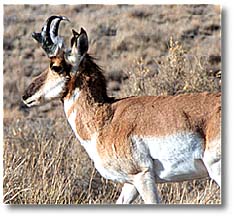
When I first got here, people told me Pronghorn were related to goats.  They’re not.  In fact, they’re not antelope either. They’re completely their own thing.  Antilocapra americana are the sole surviving member of a family dating back 20 million years, which means they’re an ancient animal.  They don’t quite fit into any category.  They have horns that are somewhere between antlers and horns,  that shed and are branched; they lack dew claws, and  can pick up movement 4 miles away. They are super fast and love a good race.  There are many stories of them racing cars at 60 mph and beating them.    At one time they were probably as numerous as the bison, and were slaughtered at the same time.  Today most Pronghorn live in Wyoming and Montana, and probably total around one million.  Male Pronghorn

We  headed back towards the car and I picked up a small old pronghorn horn.  I dropped W__off and did some shopping in Cody.  In the health food store, I noticed at the counter there was notice urging me to call my congressperson about a bill to make organic farming illegal.  The sheet said that Monsanto, the GMO giant, was behind the bill.  I talked with the store owner about it.

“Its’ outrageous.”  he said.  I agreed.  Monsanto are corporate crooks, I added.

“You know who it is, don’t you.”  He looked at me perfectly seriously and said, ” It’s the communists.”

And even I started to think, “Maybe its the communists who were killing those coyotes.”

The bighorn sheep of Little Bald Ridge

The ranch manager told me yesterday that the three wolves who were shot last summer for cattle predation were terribly mangy.  Mange is the latest big problem with wolves in the GYC.  Mange is a mite that burrows into the skin of an animal, causing it to scratch.  It doesn’t kill the wolf, but in a harsh winter they can die with the thin coat.  I heard that mange was brought into this country early last century to kill coyotes but I haven’t been able to verify that.  One of the interns told me he thought that if a wolf can make it through one winter with the mite, he’ll do o.k. after that.  Maybe some kind of resistant or tolerance occurs.

Last summer I did have a fairly close encounter with a wolf.  That black wolf was beautiful and fluffy; no mange there.  I was walking through a lightly wooded area off-trail when my dog stopped about 8 feet in front of me and stared at something in a shallow gully off to my left.  The whole scene took place so fast I barely had time to register what was happening.  I looked to my left and saw a smallish black animal, about the size of my dog but fluffier, about 12 feet away.  I thought it was a small black bear.  By the time I realized it was a wolf (about a millisecond later!),  my dog was gone.  Usually I carry an electric zapper on my dog for just these occasions, but the zapper was still in California from my move.

I think my incessant screaming, and the fact that that wolf was a lone yearling, scared that wolf so much that she ran off, but not before she had thrown up the contents of her stomach which I found later after my dog returned and I had calmed down.  After what seemed like an eternity, Koda came prancing back, with a shit-eating grin on his face.  In the span of those few seconds, I had both surrendered to the idea that my dog might never come back, and if he did come back, decided he was going back to the trainer’s for some additional dog-to-dog training.

Wolves kill other canines in their territory.  Doesn’t matter if its a coyote, another wolf, or a dog.  They don’t eat it, just really tear it to pieces.  Being a dog owner in wolf country means you have to be responsible and watchful.  The ranch hands at a large ranch across the river told me that the winter is really the time they need to be careful.  Although they have wolf activity there year round from the Beartooth Pack, their property is full of elk in the winter and the wolves come down more and the nights are long.  Many of the wealthy ranches here have heated kennels for their dogs.  She told me a story that last winter the dogs were out of the kennel on a cold winter day.  Luckily she was working nearby because she looked over and there was a small pack surrounding their three dogs.  She ran over, made a big ruckus, and scared the wolves away.

Another local told me he was hiking with his five year old Black Lab.  The Lab ran over and behind a large bush where he was attacked by two wolves.  Luckily, the dog lived.  But the next year they were hiking off-trail and the lab started whining and came close to this man’s leg.  In the woods about 50 feet away, several wolves ran through.  Guess that dog learned a lesson.

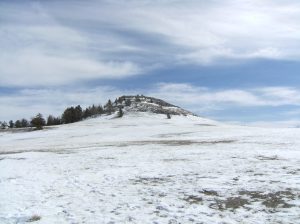
Yesterday I planned to hike up Little Bald Ridge where there’s always sheep.  As I drove down the dirt road, I could see tracks of two large wolves that had run down the road early morning. Climbing up Little Bald Ridge They always like to use the thoroughfare of that spot in the valley to go between two ridges.  As I drove bye, I noticed one of the cows just had a new calf.

Bighorn Sheep are always up on that ridge.  I tried hiking up there earlier, but the wind and snow got to me.  Today was warm and windless though and some of the drifts would have melted.  As I hiked up to the buttes, I stopped 2/3 up in a small high meadow that looks out over the entire valley below.  No wind, the silence was incredible.  A herd of elk came through the trees farther up and stopped to watch me.  They’re always skittish.  They decided I was something to be afraid of and ran up the mountain and out of sight.

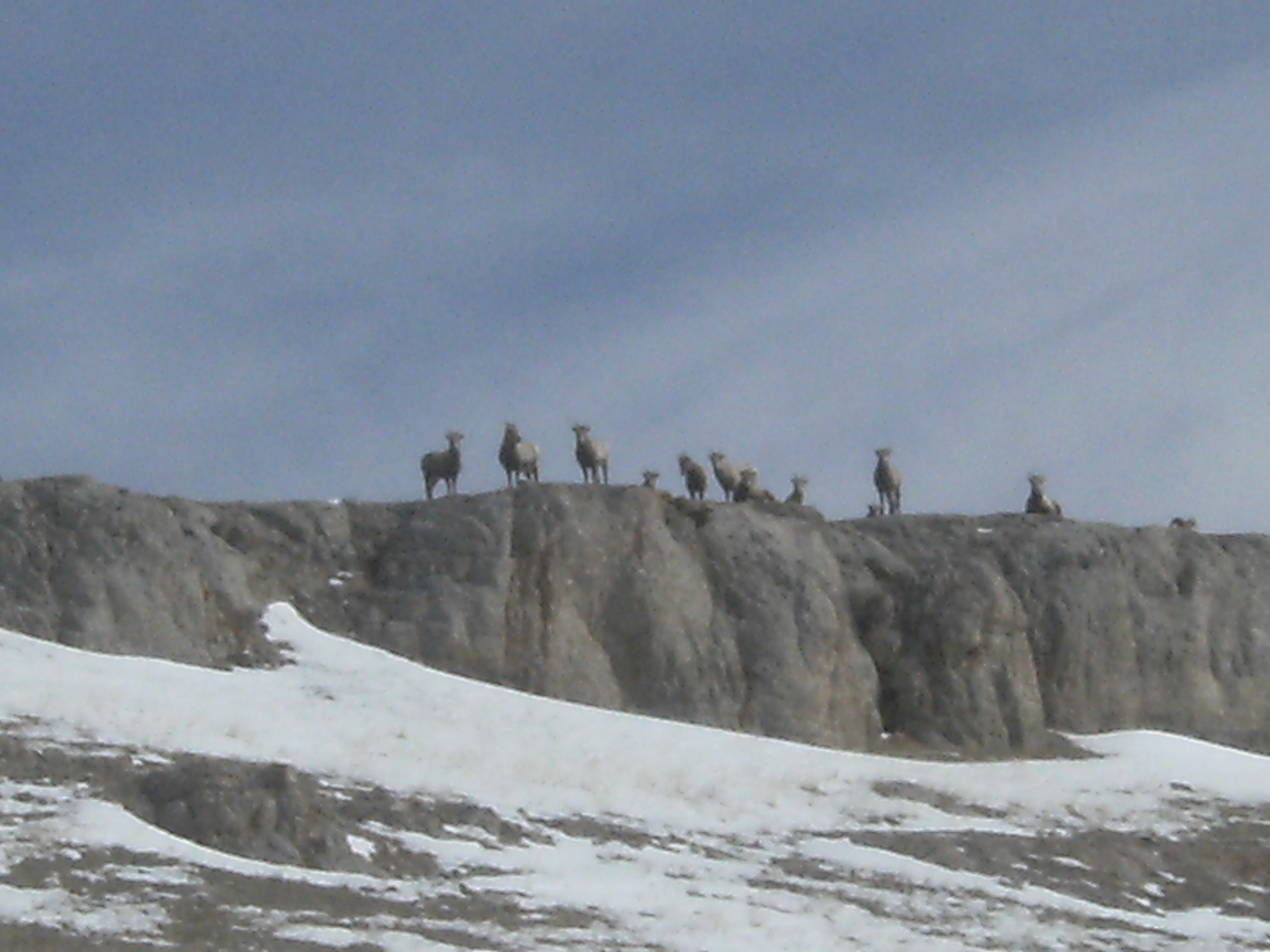
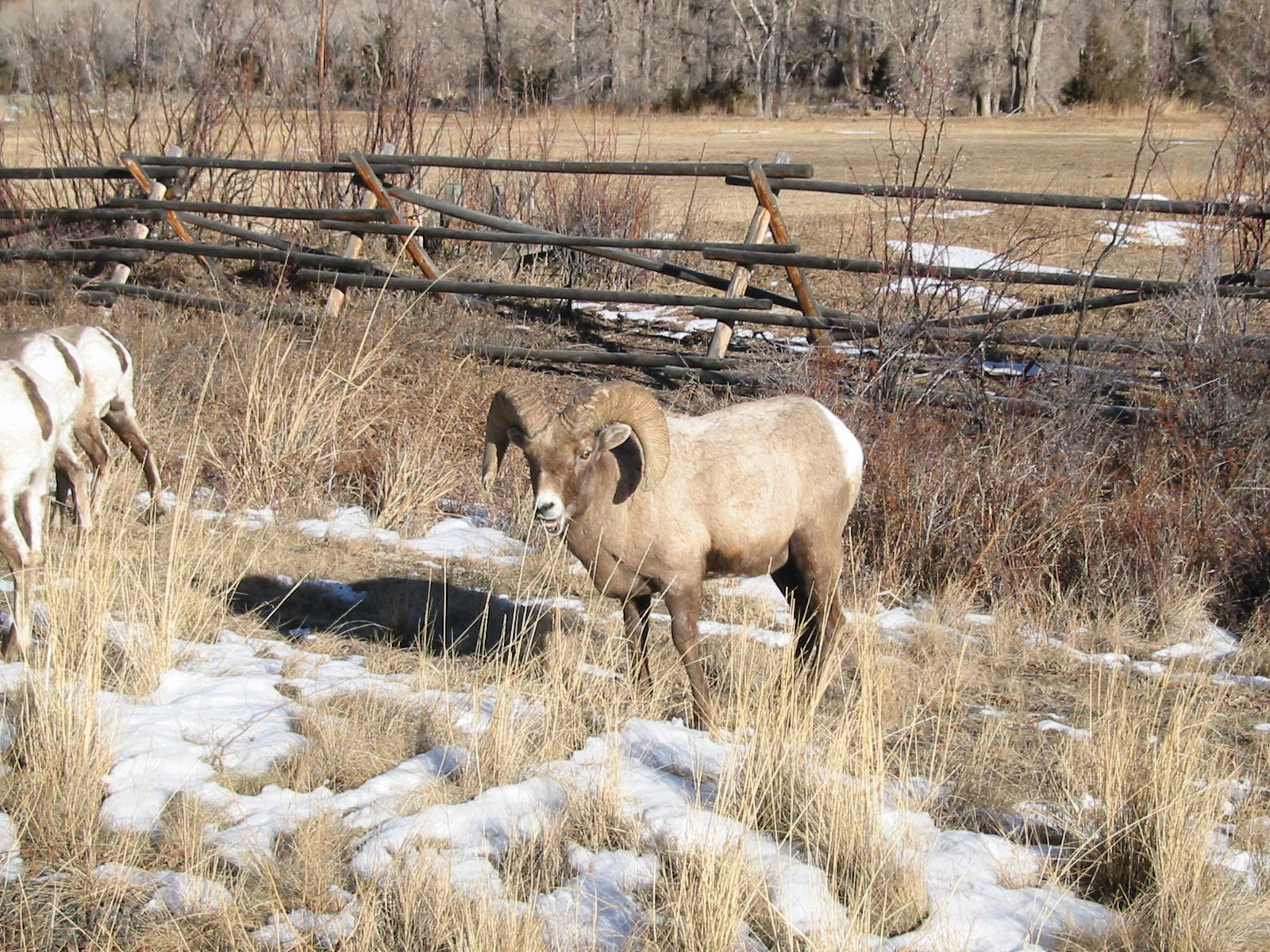
The hike isn’t Annapurna, but its a wind stopper for sure.  Its up, up and up and I hoped that when I got to the top the sheep would be in sight.  As I rounded the bend, there they were.  I kept counting, and then kept counting some more.  There were about 2 dozen sheep.  Mostly young and ewes, but I saw one nice ram.  The ewes kept watch while the ram lazed away–typical!  Bighorn are really ‘cute’.  Every time I go up there, they’re so curious.  Unlike the elk who always just run, the sheep stare and stare the closer you get.  If I didn’t have the dog, I suppose I could almost have walked up to them.

Bighorns depend on their elders to find their wintering grounds.  This small herd is right near the stone sheeptrap that I wrote about the other day.  Of course, to be called Sheepeaters, there had to be so many more sheep around here.  My understanding was that this country was thick with sheep, not just 2 dozen.  The interesting thing is that if you look around, there are plenty of exactly similar buttes right nearby where those sheep could have been.  But every year during the winter, this is the butte they go to.  You can count 100% on finding them there.  To me, this means they have an ancient honing device in them.  They must automatically go to the same forage that their ancestors went to.

I had been wondering for some time what happened to all those sheep.   After some research, I found Bighorns had no immunity to the diseases domesticated sheep carry.  Domesticated sheep grazing on open pastures and private lands were and still are, wiping out the Bighorn population.  And to the Bighorns, domesticated sheep just look like sheep; and being so friendly, Bighorns like to mix it up, unlike wolves.

The Bighorns on Little Bald had several yearlings, but I only saw one baby, at least so far.  After a while they got used to me and Koda, and went back to their business of eating.  The ram finally got curious enough to stand up for me to view him.  The baby ran with his mother.  The yearlings stayed in a small group with some ‘nurse ewes’ who watched over them, nuzzling occassionally.  I would have stayed for hours and watched them, but it was getting pretty cold and windy up there on the ridge.

The Sheepeaters

One of the interns gave me a book of Robert Service poems.  Oh, how I like so many of them.  Here’s a few verses from one of my favorites called ‘The Spell of the Yukon”

The summer — no sweeter was ever;
The sunshiny woods all athrill;
The grayling aleap in the river,
The bighorn asleep on the hill.
The strong life that never knows harness;
The wilds where the caribou call;
The freshness, the freedom, the farness —
O God! how I’m stuck on it all.

The winter! the brightness that blinds you,
The white land locked tight as a drum,
The cold fear that follows and finds you,
The silence that bludgeons you dumb.
The snows that are older than history,
The woods where the weird shadows slant;
The stillness, the moonlight, the mystery,
I’ve bade ’em good-by — but I can’t.

There’s a land where the mountains are nameless,
And the rivers all run God knows where;
There are lives that are erring and aimless,
And deaths that just hang by a hair;
There are hardships that nobody reckons;
There are valleys unpeopled and still;
There’s a land — oh, it beckons and beckons,
And I want to go back — and I will

Its interesting how one can feel a place.  Up the dirt road towards Yellowstone, there’s an area that just feels good.  The wolves like to den there, the Bighorn sheep hang on the cliffs there, and the Sheepeaters had winter camp there for 5000 years.  Keep going farther up that road, about 20 miles, closer to Yellowstone, and the feeling changes.  Something about that area always feels ominous to me.  As the valley narrows, the Absarokas close in.  Volcanic in nature, the mountains tell the story of fire and ice with their knife edge ridges and slopes of scree.  I’m always a little uneasy up there.  Its beauty and wildness belie ancient and ominous secrets.  I’m wondering ‘What happened here?’

But my story is about the area that feels good.  Last summer I spent a long time looking for a ‘sheep trap’.  I’d been told about one that was a small cleft in the rock face.

W___ had told me there was a sheep trap up in the timber, yet everytime I looked I couldn’t find where he said it was at.

Sheeptraps were used by the Native Americans who lived around here.  A sub-group of the Shoshones, they were named Sheepeaters because their primary diet consisted of Bighorn Sheep.  They made the finest bows out of horn, used no horses, and went back and forth into the Park.  These sheeptraps were one of their ways of hunting.  Usually placed along a game trail and on the downhill slope (Sheep always see what’s coming from below, but never tend to look up for danger), the traps had drive lines of dead wood that lead to a pen.  Once in the corral, then animals were usually bludgeoned to death.

I spent many days looking for the trap.  My mistake really was to go on W___ ‘s advice.  There WAS a trap he knew about up there, but it wasn’t the natural rock formation one.  He’d only been there once, and since he didn’t know this area well (he’d gone with another person who did) his directions were weak.  One time I hiked way up the mountain through several meadows.  I was tired and it was getting late. Turned out I was only a few hundred yards from the trap in the woods.  But when W__ did take me there later on, I didn’t feel so badly, for I talked with several hunters who’d walked right by the trap and never saw it.
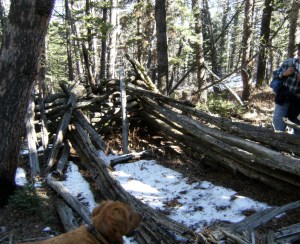
Partially buried sheep trapThe wooden trap was awfully small, but when you looked closely, it was obvious that it was buried deep.  The wood was old and it was amazing the construction was still intact.

I knew that there must be another trap somewhere else.  I decided to walk along the cliffs farther down the meadows.

Fall was in full force and the days were short.  One afternoon I took a few hours and hiked up to the bottom of the cliffline.  I walked its edge.

The view was fabulous from up high and I stopped to investigate a natural arch.  There was nothing inside but packrat remnants.

Farther along the wall, I came to an extremely narrow notch in the wall.  Some unknown force drew me to climb up it to the landing above to investigate.  I hesitated.  The light was getting low, I was running out of time, and this seemed like just a curious sidetrack.  But I couldn’t resist.  I scrambled on all fours through some snow and debris up the cleftt to small flat area above.  Walking around on top of the rock, I noticed a second but larger cleft between two gigantic boulders.  The boulders narrowed sharply and a tree was growing at the base.  It was a curious natural formation.  A few pieces of wood and debris were inside.  I looked around but saw no evidence of any drive lines.

I climbed back down the notch and continued making my way along the wall.  In short order I came upon a dry creek bed and an old game trail that led to the landing up above.  It was then that it hit me–That cleft WAS the pen, just a natural one.  It was so obvious.  I raced back up the ravine as the sun was starting to set.  Sure enough, the game trail passed a few hundred feet above that cleft.Looking from above
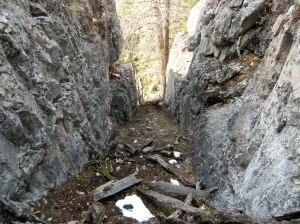
And now I noticed random wood above the cleft, probably strewn around for the last hundred and fifty years, once used as the drive line.  The whole setup seemed so ingenious to me, with the minimal expenditure of energy.  The ancient game trail right there, the Sheepeaters waiting in the timber above, the natural pen below.  If you walked from the cliff line below, you’d never notice this pen because of the tree and a good amount of debris placed there to block the exit.

I sat down at the top of the rock and watched the setting sun.  I marveled at how by trusting a feeling I found this place.  And the moment of ‘Ah ha’ that came from the inside out.    It was getting cold now.  But I took a little time to sit and say ‘thank you’ to whatever bought me here.

Teepee Rings and the Spirit Wind

Someone gave me one of those mid-range expensive weather stations, the kind with an indoor readout that talks with an outdoor unit.  It also talks to a satellite for date, time, and moon phases.  There is a feature on it that tells you a forecast: an arrow up or down, sun or clouds.

This morning I looked at the forecast on the readout.  It featured clouds and the arrow was down.  Ten minutes later W___ called and asked about a hike today.  I looked at the readout and the arrow was up.

Frankly, that about says it all for Wyoming weather.  JB, my 84 year old neighbor, tells me the old saying is “If you don’t like the weather in Wyoming, wait 10 minutes.”  I think my digital weather station feels like its riding a bucking bronco sitting on my window sill forecasting mountain weather.

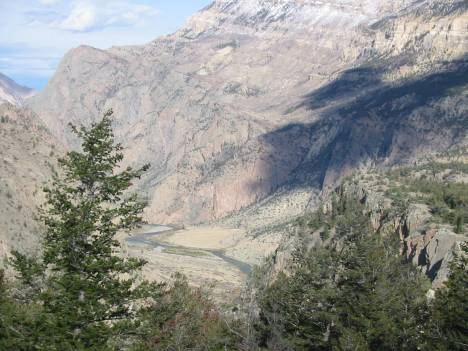
W___ and I decided to meet down the mountain and go for a hike out near the mouth of the Clark’s Fork river.   The Clark’s Fork barrels down the canyon from the Beartooths, carving a deep gorge over a mile deep in places from the high plateau where I live.  Chief Joseph led his people through here, pursued by the army, fleeing to Canada.  The reason he knew the area so well was because the Nez Perce had been coming here every fall to hunt buffalo.  By 1840, the buffalo had disappeared from Idaho.  The Nez Perce had to decide to either change their diet or migrate yearly to Wyoming to hunt.  They used traditional trails through the park and into the Great Basin of Wyoming.  Clark's Fork of the Yellowstone River

Today was incredibly windy.  The winds were traveling at breakneck speed down the canyon.  Sometimes gusts blew me off my feet.  Huge clouds of water blew like ghosts off the river.  W__ said it was a ‘spirit wind’.

We park at the end of a dirt road that once was a Ranch.  W__ tells me that about 12 years ago there was a large drug operation at the ranch, the owners were busted by the Feds, and because it was a Federal operation the ranch became federal property.  Eventually the state took the ranch over.  Now, its just old buildings boarded up.  We walk around in the hurricane force wind.  The main house is all boarded up, but several cabins are still open.  Most are filled with packrat items, but others have old signs and refrigerators in them.  One is filled with rolls of carpet.  The ‘drug ranch’ sits on the flat sagelands, next to the river, with old Cottonwoods surrounding it that some previous owner planted.  Its a perfect movie set.  The story goes that one of the druggies got out of prison early and went back to the ranch in the night to dig up drug money that they’d buried there.  Koda’s running around like crazy after jack rabbit scents.  I humorously instruct him to ‘Look for the money, Koda.”

The river, once roaring and wild, settles down here at the mouth and swings gently along a wide, broad plateau. We walk much further down the old dirt road, off the ranch, and towards the mountains.  W___ points out the numerous teepee rings.  At first I can’t see them well.  They’re old and the rocks are deeper in the dirt than ones I’ve seen before.  I kind of have to squint, unfocus my eyes and let my mind flow.  Soon, I’m spotting them too.  Their openings are to the east.  A few even have old fire rings in the middle.  We’re at the end of the plateau where W___ tells me the rings are large.  I ask him why some of the teepees are smaller and some are larger.  “I’m just guessing here, Old teepee rings.  Can you see them?but my theory is that the larger rings were for families that might have stayed longer; whereas the smaller teepees were temporary hunting parties.”  I like to try and imagine the community spirit that once was here, bustling with excitment and activity for the fall hunt.  Its in sharp contrast to the drug ranch of secrecy and isolation.

Yet all that’s left of both of them are a few signs, a desolate area, and a fierce wind–a ‘spirit wind’.  Newer teepee rings in the Bighorns

The Shepherd

During the elk capture, the ranch hand from the Dude Ranch down the road offered his meadow for us to watch from.  He’s a real character with some funny stories.  I asked if those were his cattle grazing on forest service land in the summer way down towards the end of the valley.  He told me they were.

“The hunters come with their weed-free high quality expensive hay for their horses.  They leave it out in the backcountry and our cattle eat it.  Then they get angry, so I just give them some of our hay, grown here.  Not such good quality you know.  Its a good deal for me.  Then the Ranger comes and says ‘Hey, is that certified?”  And when they say it is, the ranger says ” Where’s your tags?'”  I laughed just thinking about that.

My valley runs from the main highway about 35 miles west and butts up against Yellowstone which is just over the Absaroka Mountains.  Problem grizzlies get dropped off there in the summer.  I’d seen his cattle way far back.  I asked if he’d had much cattle predation.

“Don’t have any.  Never have lost one cow.  The Fish & Game guys always ask ‘What are you doing? How come you have no losses?’ and I tell them “I don’t know why.  I don’t do anything.  Maybe it’s because the cattle are in the trees back there.”

Last summer several calves were killed on the other ranch towards the head of the Valley.  That rancher keeps his cattle mostly enclosed in one area, which is where they were predated on.  I suggested maybe it was a lot easier when you knew exactly where the cattle would be every day, like going to the refrigerator.

C___, the ranch hand, has 17 cows about to give birth and has been coming out every 2 hours in the night to keep the wolves away.  He’s shepherding them.  We asked if we could help birth the calves.  He said its easy.  He’d call us to help.  I hope he does as it sounds fun.

Ranch where cattle were predated upon

The Dreaming

This winter I went to Australia with my son.  Its the perfect place for a California Landscape Designer to explore, as its just one of the five Mediterranean climates around the world.  I use a lot of the plant material from there, and to see these plants in their native environments is interesting and instructive.

I was in Australia for several months over twenty years ago, so this was my second visit.  I planned to go back to Sydney (I almost moved there 20 years ago), then venture up to the Daintree, the world’s oldest tropical rainforest and a UNESCO site (north of Cairns) and then to Atherton Tablelands wetlands retreat in a savannah ecosystem.  My son has a teacher from Australia who said “You MUST go to Uluru.”  I hadn’t planned to go there.  I knew about Ayers Rock for a long time.  It’s a long trek, by plane or otherwise, to see ‘just a rock’ I thought.  Besides, I live in a most beautiful place, surrounded by magnificent mountains and rock features, geysers and wildlife.  I’ve visited many deserts and spent a lot of time in Death Valley and Joshua Tree.  What could one rock in the middle of the country possibly hold for me?

My travel agent also brought up the idea, and since we were in Australia over Christmas and many places were shut down for several days, Uluru seemed like a likely ‘detour’ during that lull.  We were to be there for a day and a half and then drive to Alice Springs.  But the holiday put a wrench in the travel plans…ferries didn’t run, planes had restricted schedules, etc…so we spent an extra day in Uluru/Kata Tjuta area.  It wasn’t till later that I realized things had conspired to bring us there for a fuller experience.

Uluru

Read the whole story